Introduction #
One of the driving forces behind my novel “Intergalactic” was that I had grown tired of science fiction featuring aliens that are less diverse than your average inner-city shopping mall.
In the game as well as the book one of my goals is to make aliens really alien, and to consider what that all means. This includes a lot more than just making them look not like humans with make-up.
Habitable Environments #
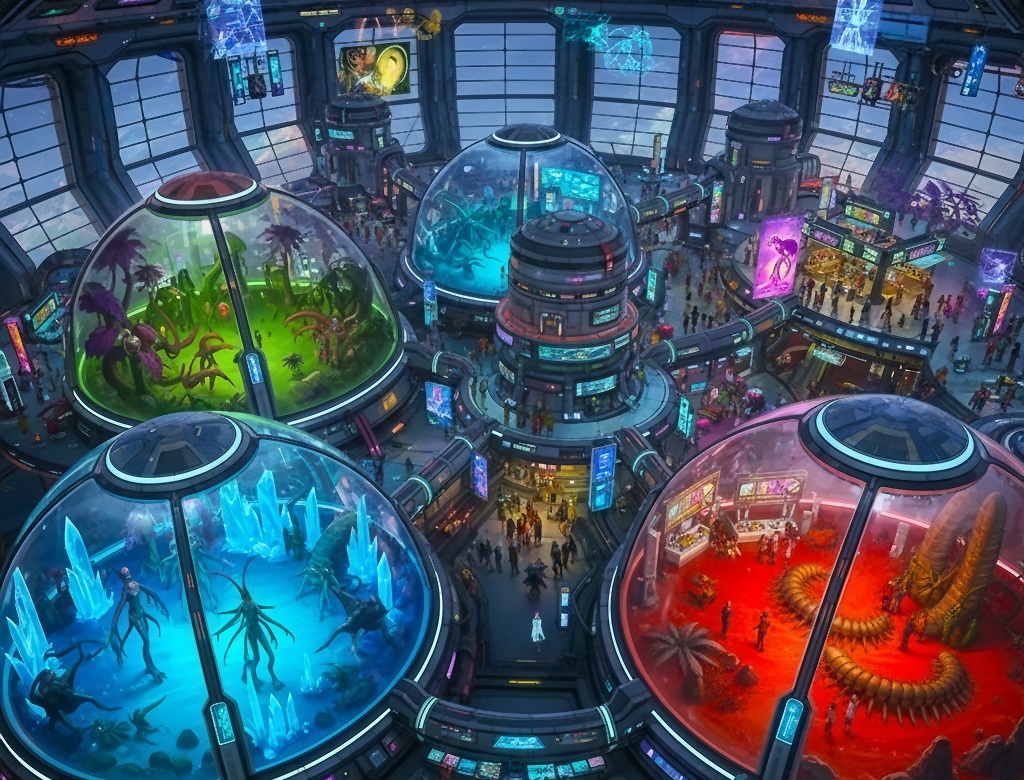
In “Intergalactic” there is a scene where a delegation of Felindar visits a human planet. The Felindar are a bird-like species. But that is not what makes them alien. The scene plays in a meeting room that is split into two parts by a glass wall - because the Felindar breathe a different atmosphere, are used to different gravity, their native environment is quite different from Earth.
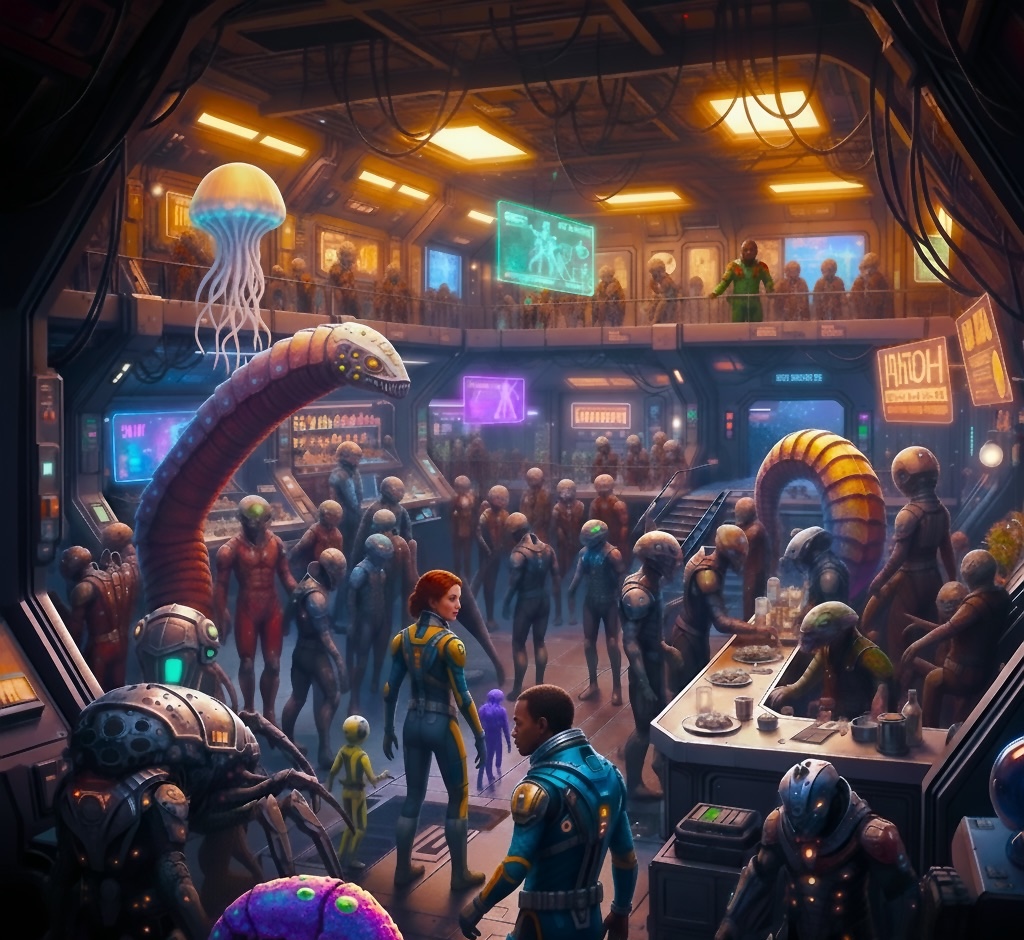
The logical consequence is that the movie image of a bustling space station with all kinds of aliens wandering the hallways is highly unlikely. If different aliens share a space, most of them will have to walk around in space suits.
Dimensions & Gravity #
Another aspect specific to the universe of this game (and the book) is that different alien species experience different amounts of dimensions. This is not just the backstory of why some high technology is so hard for humans, who as 3D creatures, or 4D if you include time, are rather on the low end. There are aliens in the galaxy that live in six spatial and two time dimensions. What for them is a simple “here, take this and put it over there” is a multi-year research project with custom-built tools for humans.
Not to mention that most planets in the galaxy have a different gravity than Earth does. And not a bit more or less. In the universe I’ve built, there are aliens living on planets with a fraction of Earth gravity as well as some hailing from planets that would squish a human into a pancake. Even with technology that allows for gravity manipulation, these creatures cannot share the same space and all feel even remotely comfortable.
Alienation #
Aside from a more realistic world-building, all of this also serves the game as a means to create a strong separation between the human player and the aliens encountered. These creatures are not just slightly different looking. They are not a stand-in for a different skin colour or culture. They are truly alien. They are different to the point of incomprehensible.
Not all to the same degree, mind you. Some aliens are not too different from humans. Maybe a bit smaller or bigger, maybe breathing a different atmosphere, but more or less living in the same world. Others though, have such a different experience of the universe that humans cannot relate to them in any way.
And this is where trade comes into play. As a concept that most aliens in the galaxy share. The exchange of goods for a mutually accepted currency. It is a concept so obvious and so beneficial to all involved, that even on Earth it has been discovered independently in different cultures. True, there are, in parts until today, different understandings of what can be traded and how exactly. Other humans (slavery) or the land itself (real estate) were considered tradeable or not in different times and cultures. But the basic principle of exchange is something that I consider universal enough that galaxy-wide trade is possible.
And where the differences between alien species’ can be an advantage. For humans, FTL technology is an insanely hard problem. In this universe, they barely manage to get the most simple prototypes working. And some of the time, they don’t even explode. Meanwhile, for many higher dimensional beings in the galaxy, an FTL drive is a fairly straightforward engineering challenge. Sure, it was tricky to come up with the first one, but once it’s an understood technology, a standard hyperdrive is their equivalent to a human jet engine - not trivial by any means, but easy enough to mass-produce.
Trade Limitations #
And that brings us around to trades that don’t happen. As I have explained in detail in the previous devlog (Re-)Inventing a Galactic Economy, three types of goods are reasonable to be traded between solar systems: The very rare, high-tech and local specialties.
This gives us three tiers for trading:
- Rare materials are always a possible trade, though how valuable they are can vary by location.
- High-tech is traded from high-tech places to lower-tech places, but that is quite reliable.
- Local specialties depend on a factor I call compatibility in the game. Humans cannot appreciate 6D art much, because a good part of it is simply invisible to them. Likewise, most aliens cannot digest human food. But when compatibility is sufficient, the market value can be quite high because the stuff is exotic.
Game Considerations #
Aside from this, the being-alien-to-each-other factor comes into play in two other places in the game. First, as already explained in Space Freighters, buying a spacecraft from an alien race isn’t so easy, as they need retrofitting for humans. This explains why there are at best a few and sometimes none at all for purchase in the trade ports. As a game-mechanic, I wanted hunting for a good freighter to be part of the game, not just a question of having the money, but also of finding someone who sells one. Second, it allows me to add some randomness to the diplomacy and personal relations. Simply being on an alien space station has the potential of them becoming interested in YOU (the player) being the truly alien, well, alien; and also you could break a dozen cultural taboos without even noticing.
Closing Words #
It’s been quite a while since I posted the last devlog. Almost four months to be precise. Work on the game has been slow in that time, I must admit. First, there were things in the real world taking my time, energy and attention. Second, I needed to straighten out a few design choices, concepts and systems.
Now, however, work on the game continues and there will be more updates soon.
If you haven’t already, make sure to wishlist the game on Steam. It really makes a huge difference to small indie developers like me.